Chestnut Hill Is a Historic District. That Doesn't Mean What Most Buyers Think It Means.
September 17, 2026
September 17, 2026
Ask most buyers what a historic district does for a house, and they will tell you it means the house cannot be torn down. In Chestnut Hill, that assumption has already been tested in public, and found wrong.
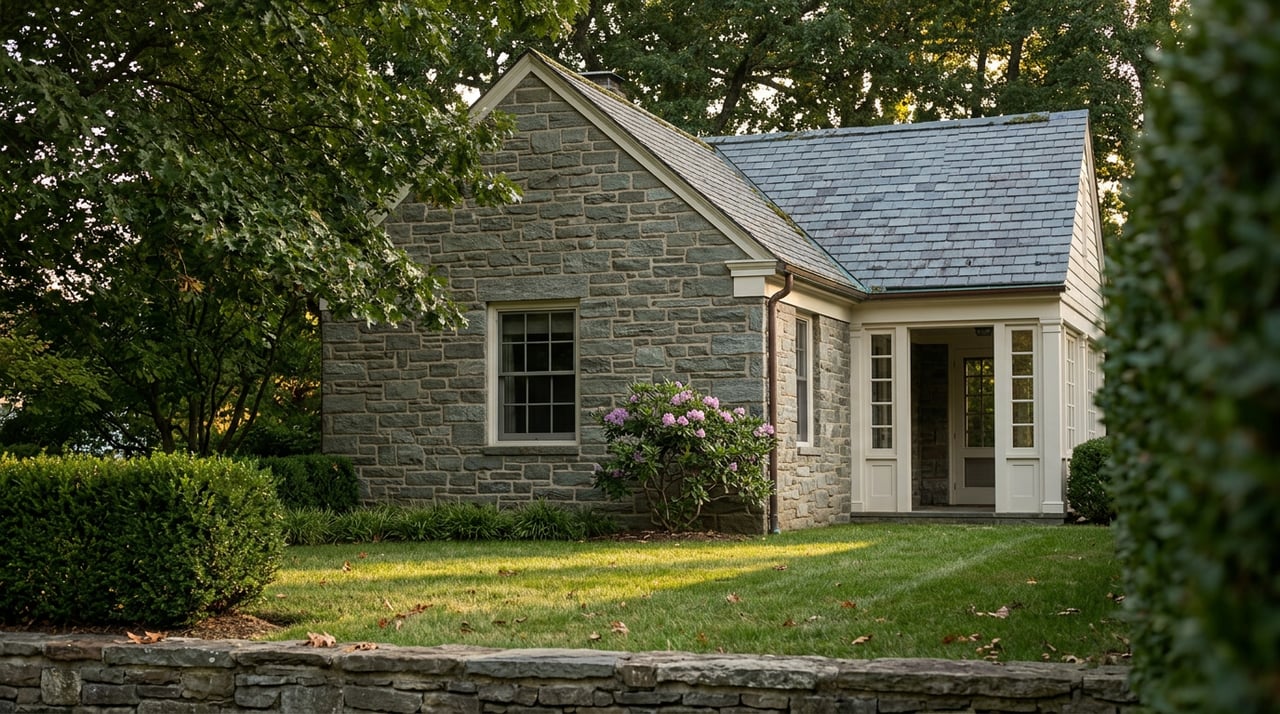
The clearest case involves a 130-year-old stone house at 30 W. Chestnut Hill Ave., designed by Theophilus Parsons Chandler, the architect who founded the University of Pennsylvania's architecture program. In 2019, the trees on the property were removed and the new owner applied to demolish the house. The demolition permit was pulled the same day the developer took possession of the property, according to Lori Salganicoff, then executive director of the Chestnut Hill Conservancy. The house sat inside Chestnut Hill's National Register Historic District, the exact designation most buyers point to as proof that the neighborhood's character is protected by law. That designation did nothing to stop the permit.
What actually saved the house was fifteen months of negotiation between the Conservancy and the developer, Main Street Development Company. The deal, announced in June 2020, placed a conservation easement on the original structure and allowed the developer to subdivide the lot and build one new twin home beside it. Salganicoff later called the episode a wake-up call for a lot of people to recognize that could happen in a second.
That gap between what a historic label implies and what it actually enforces is the thing worth understanding before you fall for a stone facade in Chestnut Hill.
The Conservancy's own account of its work is direct about this. The National Register Historic District, which the Conservancy's predecessor organization spent years documenting before completing the nomination of thousands of buildings in 1987, is primarily an honor and an incentive. It can make a property eligible for federal historic tax credits, and it can trigger a federal review process called Section 106, but only when federal funding or permits are involved. It does not, on its own, restrict what a private owner can do to their house.
Real regulatory teeth in Chestnut Hill come from two narrower tools:
Individual local designation by the Philadelphia Historical Commission applies to a small number of specific properties, not the neighborhood as a whole. A designated property needs a Certificate of Appropriateness before exterior work visible from the street, including window replacement or demolition, which typically means a Commission hearing for anything major.
Conservation and preservation easements are private, voluntary agreements between an owner and the Conservancy. As of the Conservancy's most recent count, there are 52 of them across Chestnut Hill and the surrounding watershed, protecting about 105 acres total. An easement is negotiated property by property. It is not a blanket rule.
Put those together and the picture is plainer than the branding suggests. Chestnut Hill has an impressive National Register designation and a genuinely small number of properties with binding, enforceable protection. As the Conservancy's own materials note, there is currently no local historic district covering the neighborhood as a whole.
Here is the part that inverts most buyers' instincts. Philadelphia's zoning code sets the minimum lot size for the RSD-1 district, the category that covers most of Chestnut Hill's detached single-family streets, at 10,000 square feet with 75 feet of street frontage. That is roughly a quarter acre. A great many Chestnut Hill lots are far larger than that. Half-acre, full-acre, and multi-acre parcels are common on the neighborhood's back streets, and under the same zoning code that governs a modest twin lot.
That means the biggest, oldest, most architecturally serious properties, the ones a buyer would assume are the most protected because they look the most historic, are often the ones with the most legal room to be subdivided. A developer does not need to demolish a National Register home to build something new next to it. The zoning already allows it.
This is not a new fear. In 2017, a 104-year-old Colonial Revival house on West Moreland Avenue, designed by architect Charles Barton Keen for Charles Bromley, became the center of a preservation fight after its owner obtained a zoning permit to subdivide the lot for two new homes and sought a demolition permit for the original house. Jennifer Hawk, then executive director of the Chestnut Hill Historical Society, put the underlying risk plainly: if a property becomes more valuable than the house itself, we're in trouble.
The current market gives that math a sharper edge. As of July 2026, Chestnut Hill's active listings carried a median list price of $862,000, while the same month's closed sales landed at a median of $1.25 million on just 11 transactions, a small, luxury-heavy sample. At the same time, the regional demand index that tracks single-family homes by price tier showed the luxury segment falling nine points to a reading of 72, the steepest drop of any segment tracked that month, while condos and townhouses held steadier ground.
Read together, that is a market where large, historic-caliber single-family homes still command real premiums on the rare occasions they sell, but demand for that specific tier is softening faster than the rest of the neighborhood. When it gets harder to find a buyer willing to pay a premium for an aging house on a big lot, the alternative math, land value plus one new construction lot, starts to look relatively more attractive to whoever owns that parcel next. The zoning quirk and the current demand data point in the same direction.
The Conservancy is aware of all of this, which is why its own strategic direction is shifting. Under its 2025 to 2030 Strategic Plan, the organization named the creation of a genuine local historic district, one with the legal standing the National Register lacks, as a multi-year goal. Executive Director David Gest, who came to the role with a background as a zoning attorney, has said the Conservancy wants to walk the community through what that would mean, since a real local district comes with obligations for homeowners as well as protections, before proposing one.
No district has been adopted, and no timeline has been set. That matters for anyone buying now. You are purchasing under the current rules, where the strongest protection an individual owner can get is a designation or an easement they negotiate themselves. Those rules could look different by the time you sell.
A listing that calls a home historic is describing an aesthetic, not a legal status. Before treating that as a guarantee:
Ask whether the specific property carries individual designation from the Philadelphia Historical Commission, separate from sitting inside the broader National Register area.
Ask whether a conservation or preservation easement is already recorded against the property. The Conservancy can confirm this, and it will also show up in a title search.
Check the lot size against the 10,000 square foot RSD-1 minimum. A three-quarter-acre lot with a single house on it has more subdivision potential than its age or architecture might suggest.
Talk to the Conservancy directly if any of this is unclear. The organization has now negotiated multiple easement deals, including the one at 30 W. Chestnut Hill Ave., and understands exactly which properties in the neighborhood have binding protection and which simply look protected.
Does living inside Chestnut Hill's National Register district mean I need city approval to renovate? Only if your specific property is also individually designated by the Philadelphia Historical Commission, or if you are pursuing federal historic tax credits. The National Register designation alone does not require approval for private renovations unless federal funding or permits are involved.
Can a neighbor's large historic lot really be subdivided? Yes, if the lot size and zoning allow it, and in RSD-1, the quarter-acre minimum means many Chestnut Hill lots have room to spare. Age and architectural pedigree do not change what the zoning code permits.
Is Chestnut Hill actually getting a local historic district? It is a stated goal in the Conservancy's 2025 to 2030 Strategic Plan, and Executive Director David Gest has said the organization intends to engage homeowners on what such a district would require before moving forward. As of now, none exists and no date has been set.
Does a conservation easement hurt a home's value? Not necessarily. Owners who donate an easement can claim a federal income tax deduction for the value they give up, and the 30 W. Chestnut Hill Ave. agreement shows an easement can coexist with new construction on the same parcel, since the developer was still permitted to build one additional home next to the preserved original.
If you are weighing a Chestnut Hill property against its history, its zoning, and what a developer might see in the same lot, that is exactly the kind of read Holly Reynolds does for buyers and sellers across Philadelphia and the Main Line. Request Your Free Home Valuation to start the conversation with someone who already knows which stone walls come with real protection, and which ones simply look that way.
Stay up to date on the latest real estate trends.
Transform your home journey into a memorable experience with our innovative, client-focused approach. I combine deep market insights with a genuine passion for service, ensuring that every step—from the initial consultation to closing—reflects my commitment to excellence. See the difference that makes me stand out in today’s competitive market.